Getting Started with Bug Club Morphology
Grade 2 - 7

"Morphological awareness is defined as the knowledge of word structure, including the formation of words from roots, prefixes, and suffixes—an understanding of how words can be broken down into the smallest units of meaning. Morphological awareness is critical to mastering reading skills, fostering the expansion of vocabulary, enhancing a depth in reading comprehension, and improving spelling proficiency." (Cooley, M. The Ultimate Guide to Morphological Awareness. 95 Percent Group.)
Morphological awareness is similar to phonemic awareness, and both are required to become skilled readers. Phonemic awareness is the understanding of how words can be broken down into the smallest units of speech sound, called phonemes. Morphological awareness is the understanding of how words can be broken down into the smallest units of meaning, called morphemes.
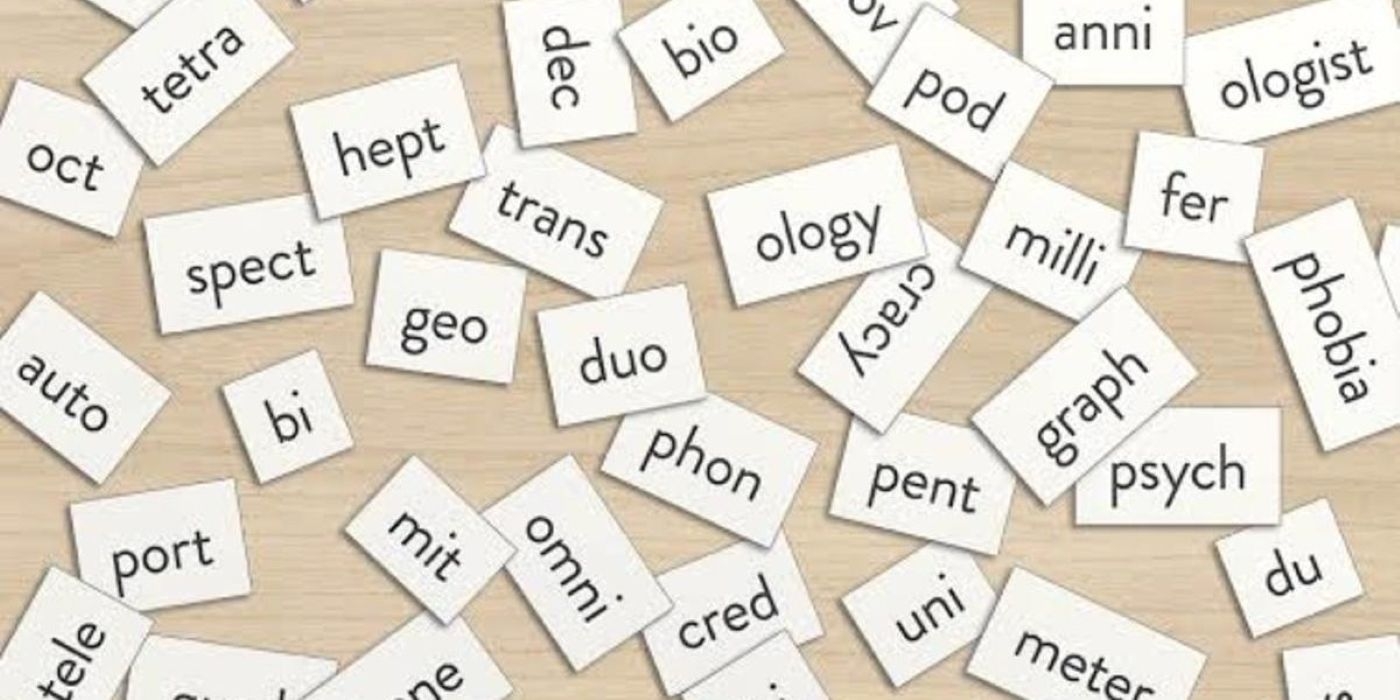
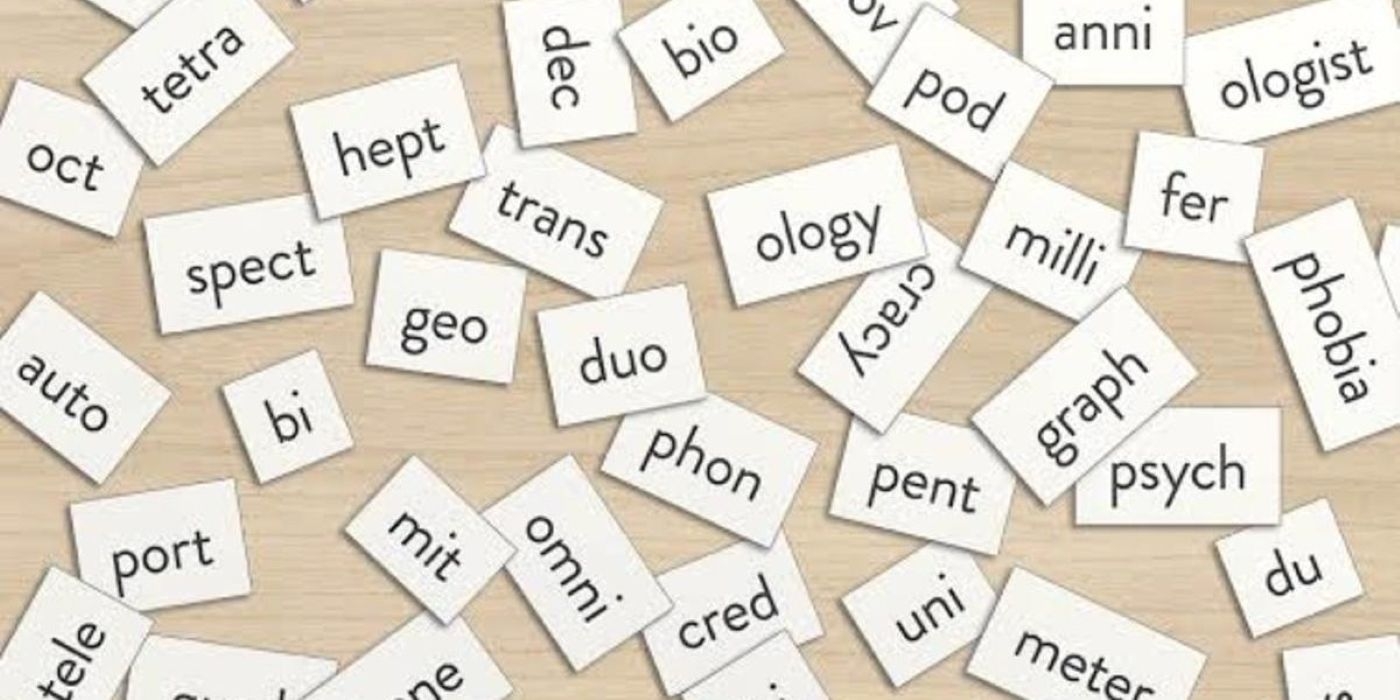
Morphemes are the smallest units that carry meaning in words. Morphology is the study of morphemes. Morphological instruction creates an awareness of morphemes that strengthens word recognition, spelling, vocabulary, and ultimately comprehension. (Glaser, D. Morpheme Magic, 2020). As students progress through school, they increasingly encounter unknown vocabulary and complex, polysyllabic words. An understanding of morphology allows them to efficiently decode, interpret, and understand these words.
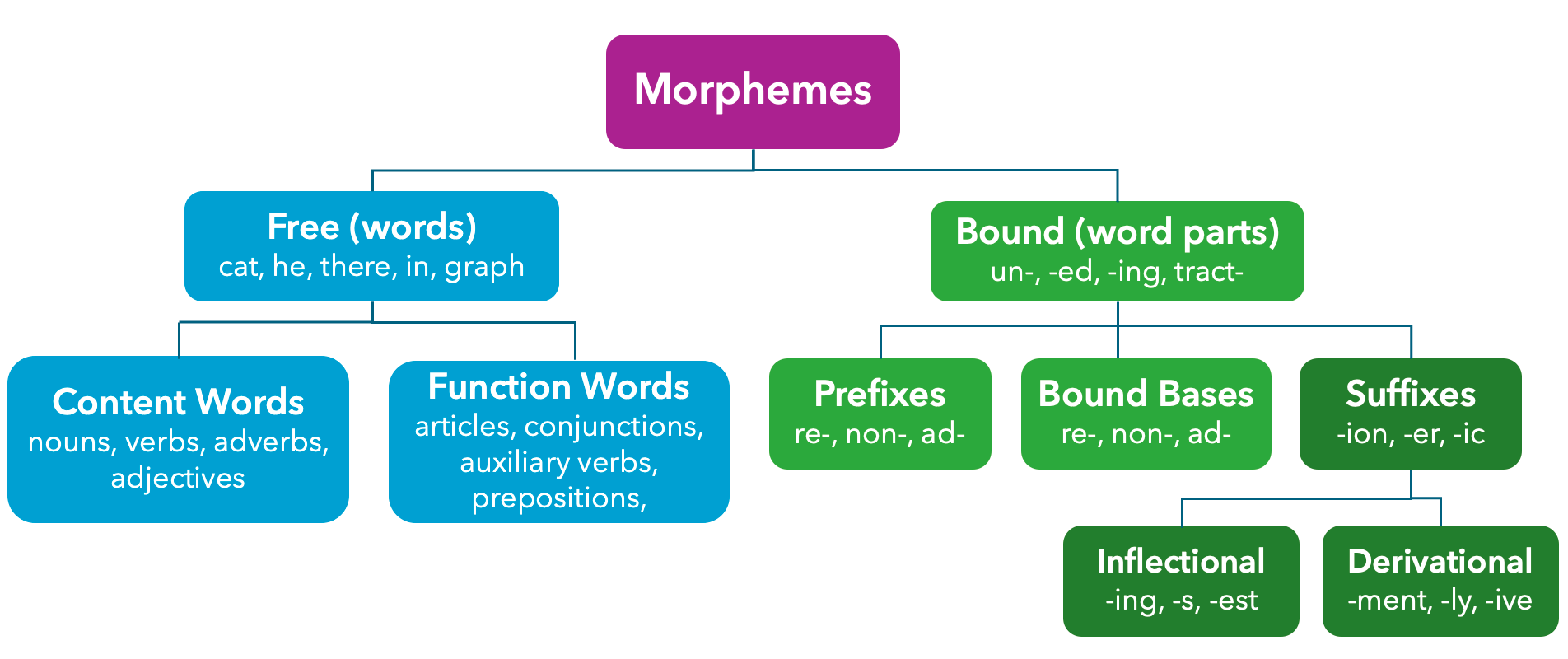
Morphemes that form English words are categorized as either free or bound. Free morphemes are stand-alone words that include both content words and function words. Bound morphemes are meaningful units that are not complete words on their own and must be combined with other morphemes to form words. There are three types of bound morphemes: prefixes, bases, and suffixes. Suffixes can be further categorized. Inflectional suffixes indicate verb tense, number of items, or comparisons. Derivational suffixes change the part of speech. (Mesmer, H. Big Words for Young Readers, 2024)
The English writing system is considered by linguists to have a deep or opaque orthography - the spelling of words represents not only phonemes and syllable patterns, but also morphemes. English orthography (spelling patterns) is most accurately described as a morphophonemic system because word spellings represent both sound and meaning. (Moats, L. Speech to Print 3rd Ed, 2020)
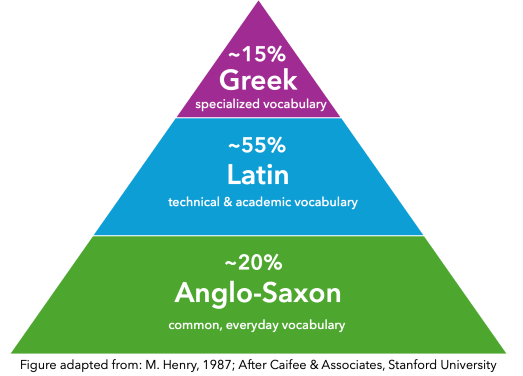
The words in English reveal a long linguistic history during which meaningful parts have been borrowed from many other languages. The base languages of Anglo-Saxon, Latin, and Greek each contribute a significant portion of modern English vocabulary (see figure below for approximate percentages). Etymology is the study of word origins. The history and origin of words are integral to understanding the morphemes, word structure, and spelling patterns of words, as each layer of language uses somewhat different word-building processes. Morphology and etymology work together to provide a more complete understanding of word meanings and spellings. (Moats, L. Speech to Print 3rd Ed, 2020; Glaser, D. Morpheme Magic, 2020)
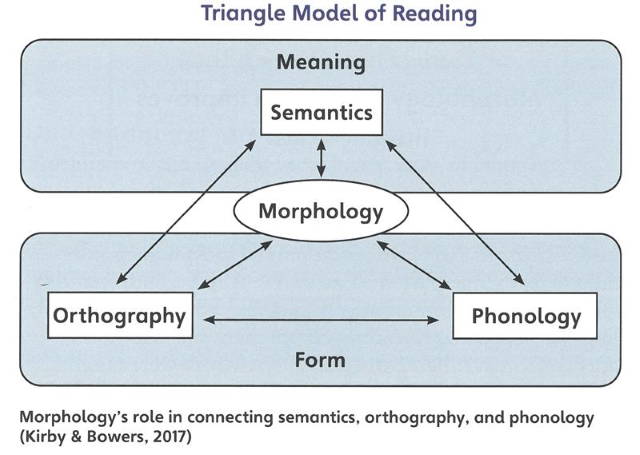
According to the 'Triangle Model of Reading', the linguistic processes of phonology, orthography, and semantics work together to help us read and spell words. Researchers have proposed that morphology acts as a binding agent; it fosters connections among the sound, meaning, and spelling of words. These connections, working together, enable students to build quality representations of words, based on their meanings, uses, sounds, and written features. (Kirby & Bowers, 2017; Perfetti, 2007) [cited from Bug Club Morphology Teacher's Guide]
The ability to use words well depends on multiple layers of knowledge that are acquired slowly, with much exposure to text - knowledge of words' spellings, meaningful parts, meanings, and grammatical use. Explicit morphology instruction is a key component of an evidence-aligned, structured literacy approach to word learning for students Kindergarten to Grade 12.
Grade 2 - 7
Grade 1 - 7

Grade 1 - 7

Grade 1 - 7
Grades 1 - 10
Surrey Schools (SD36)
14033 92 Avenue
Surrey, B.C. Canada
V3V 0B7
Phone: 604-596-7733
We are the largest school district in BC and serve Surrey, White Rock and the rural area of Barnston Island.
Copyright © 2026 Surrey School District. Developed by the Surrey Schools Literacy Team. Admin.


