In April 2024, the British Columbia government announced a significant literacy initiative aimed at improving literacy skills among students, particularly those in kindergarten to Grade 3. One aspect of the initiative is the implementation of evidence-based early literacy screening; however, elementary teachers from kindergarten to Grade 7 can effectively use screening tools to decide how best to support the literacy development of their readers.
For the 2025–26 school year, the BC Ministry of Education and Child Care has mandated literacy screening for all kindergarten learners, at a minimum. Learn more about British Columbia’s Early Literacy Screening initiative HERE.
What are literacy universal screening tools?
Universal screening tools are assessments designed to contribute to a student’s overall literacy profile by suggesting their current reading health or potential possibility of future reading difficulties. These tools play a critical role in the early detection of reading challenges, enabling educators to implement timely, targeted instruction and, when necessary, appropriate interventions to support literacy development.
"Screeners" are administered to all students multiple times throughout the school year to monitor progress and inform instructional decisions. Examples of screening tools are DIBELS 8th and Acadience Reading.
| UNIVERSAL SCREENING TOOLS ARE... | UNIVERSAL SCREENING TOOLS ARE NOT... |
|---|---|
| Efficient. The measures are timed to offer brief snapshots of essential literacy skills to monitor if students are making progress. They are designed to be administered without consuming excessive amounts of instructional time. |
Equal to the BC Proficiency Scale. These measures are not indicators of current reading proficiency, such as whether a child is emerging, developing, proficient, or extending in literacy learning. They add to a teacher’s broader understanding of the learner’s reading trajectory with the existing instruction. |
|
Standardized.
|
Diagnostic. Screening tools do not clarify what to teach to support each learner’s word recognition skills. They only suggest which learners need strategic or intensive support to boost their literacy development towards grade-stage abilities. |
| Predictive. Screening tools predict the learner's probability of reaching future reading milestones and abilities without additional strategic support. |
Comprehensive. Screening tools measure critical word recognition skills that underpin reading comprehension, including phonemic awareness, decoding, word recognition, automatic word reading, and fluency. Although accessed during some measures, vocabulary, background knowledge and language comprehension are not skills targeted in screening tools that are equally impactful to reading. |
Why are screening tools standardized?
Universal screeners are standardized to ensure consistency, reliability, and fairness in assessing students' literacy skills. Standardized screeners allow for benchmarking against established norms or standards from tens of thousands of results from students of similar age groups. This helps teachers gauge how students are performing relative to children in their grade both within your school and more broadly.
Why do screening tools include timed measures?
The measures are timed in part to ensure standardization for all learners. More importantly, the tools also measure the development of automaticity, or fluency, of essential literacy skills. The critical element of fluency must be developed for readers to achieve effortless automatic word reading and become able to place more attention to comprehension of each text.
Do screening tools uncover what to teach to impact a child's reading?
Screening tools suggest which learners need more targeted support yet do not completely clarify what needs to be taught in order to support each learner’s word recognition skills. After screening, teachers strategically select “diagnostic” assessment tools to more clearly define what to teach. Examples of diagnostic assessment tools include the SD36 Phonics Survey, ELPATS (Early Literacy Phonemic Awareness Tool Surrey) or the SD36 Spelling Survey. Learn more by viewing Session 3 of “Empowering Literacy in British Columbia” (May 2024).
Diagnostic assessments contribute additional information about readers. Teachers also document observations, conversations and student products to create a comprehensive picture of the learner to determine the most effective instruction and practices to respond.
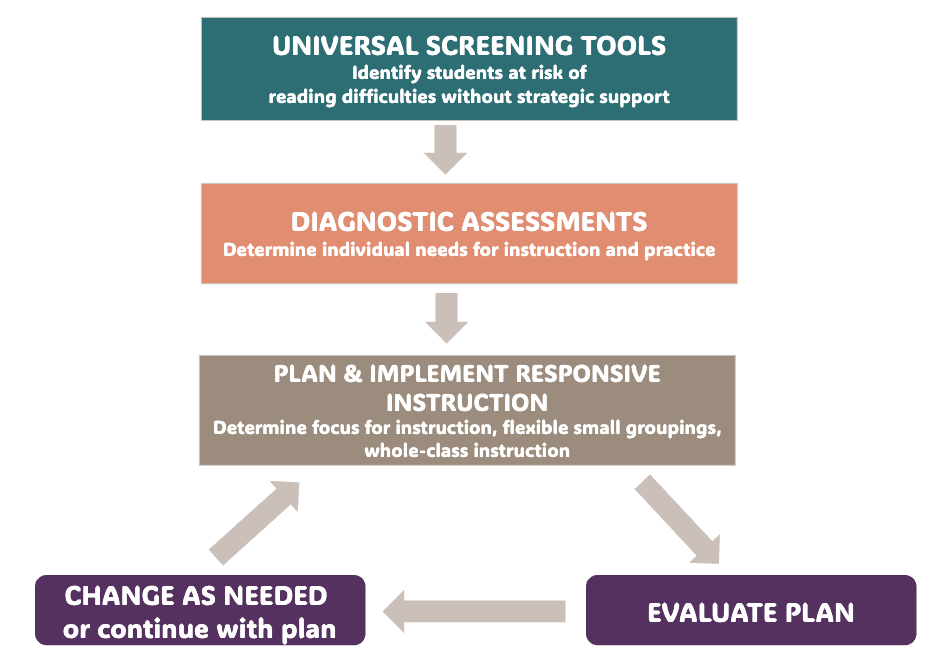
Reference: Smartt & Glaser, Outcomes-Driven Model (2023). Graphic adapted from Dyslexia Canada Series: Empowering Literacy in British Columbia (Session 3 of 4)
How can teachers learn how to use screening tools?
Scroll to the Resources section below for helpful training guides, webinar recordings and training materials to learn to use screening tools effectively. Find answers to frequently-asked questions from Ontario's ONlit organization HERE.